

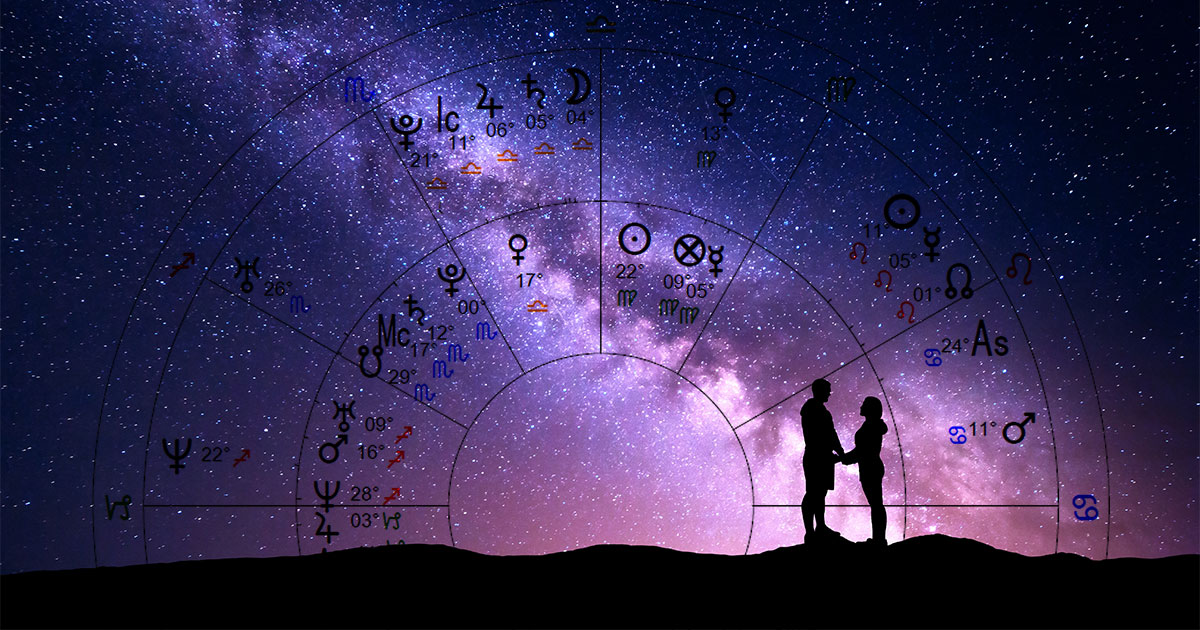
Synastry compares two birth charts. In Western astrology, you can use it to explore how two people may think about affection, communication or other parts of a connection. Start with one pair of placements and mark whose chart each belongs to.
Find the birth information and the aspect
For each person, use the birth date, time and place if they are known and the person is comfortable sharing them. The birth time helps set the rising sign and houses. If it is missing, keep those features open. Check whether the Moon’s position changes enough during the day to affect the aspect you are reading.
An aspect is an angle between positions around the zodiac. A synastry aspect compares a placement in one chart with a placement in the other. Common examples are the conjunction near 0°, the square near 90°, the trine near 120° and the opposition near 180°. Astrologers use an orb to allow a certain distance from the exact angle. Ask which orb your chart or reader uses. Astrodienst’s aspect guide explains these conventions.
Tell a synastry chart from a composite chart
A synastry chart keeps the two individual charts visible and compares them. A midpoint composite chart calculates a single chart from corresponding points in both birth charts. If you want to ask how one person’s Moon relates to the other person’s Venus, look at the synastry chart or its aspect table. See Astrodienst’s chart type descriptions.
Check the theme in your own conversations
You can use the same method for a friendship or a romantic relationship. Pick a theme, ask what it means to each person and look at what happens in ordinary life. Our guide to healthy relationship qualities gives examples of trust, respect and support you can discuss alongside a symbolic reading.