


You may be able to reconnect with your partner, but you cannot force a feeling or restore a relationship through effort alone. A useful starting point is to ask whether you both want more connection, what feels missing and what small change you would willingly try.
Staying together because of money, children, housing or other commitments does not tell you how either person feels. Nor does a quieter period automatically mean love has ended. Give yourselves room to describe the relationship you have now, instead of requiring it to feel exactly as it did at the beginning.
Name what you miss before choosing a solution
“We need more romance” can mean several things. You might miss conversation, affection, shared fun, sexual intimacy or the feeling that someone notices how much you do. Those needs can overlap, but an expensive date will not necessarily address an unfair workload.
Try a specific opening: “I miss having a conversation that is not about errands. Do you miss that too?” Listen to the answer before deciding what the two of you should do. Your partner may describe a different concern, or may not want the same kind of reconnection.
The NHS guidance on maintaining healthy relationships recommends open conversations, checking your understanding and making room for your own needs and interests. Listening is more useful when it leaves room for an answer you did not expect.
Ask whether you both want to try
You might say, “I’d like us to try spending some time together that we both enjoy. Would you like that? What would make it manageable?” This is an invitation, not a test of loyalty. A yes to one activity is not a promise to feel more affectionate afterward.
If your partner says no, you can ask what they mean, if they are willing to explain. Do not substitute a hidden intention for their answer. You can seek individual support and decide what you want to do with the information you have.
Make the plan fit your actual lives
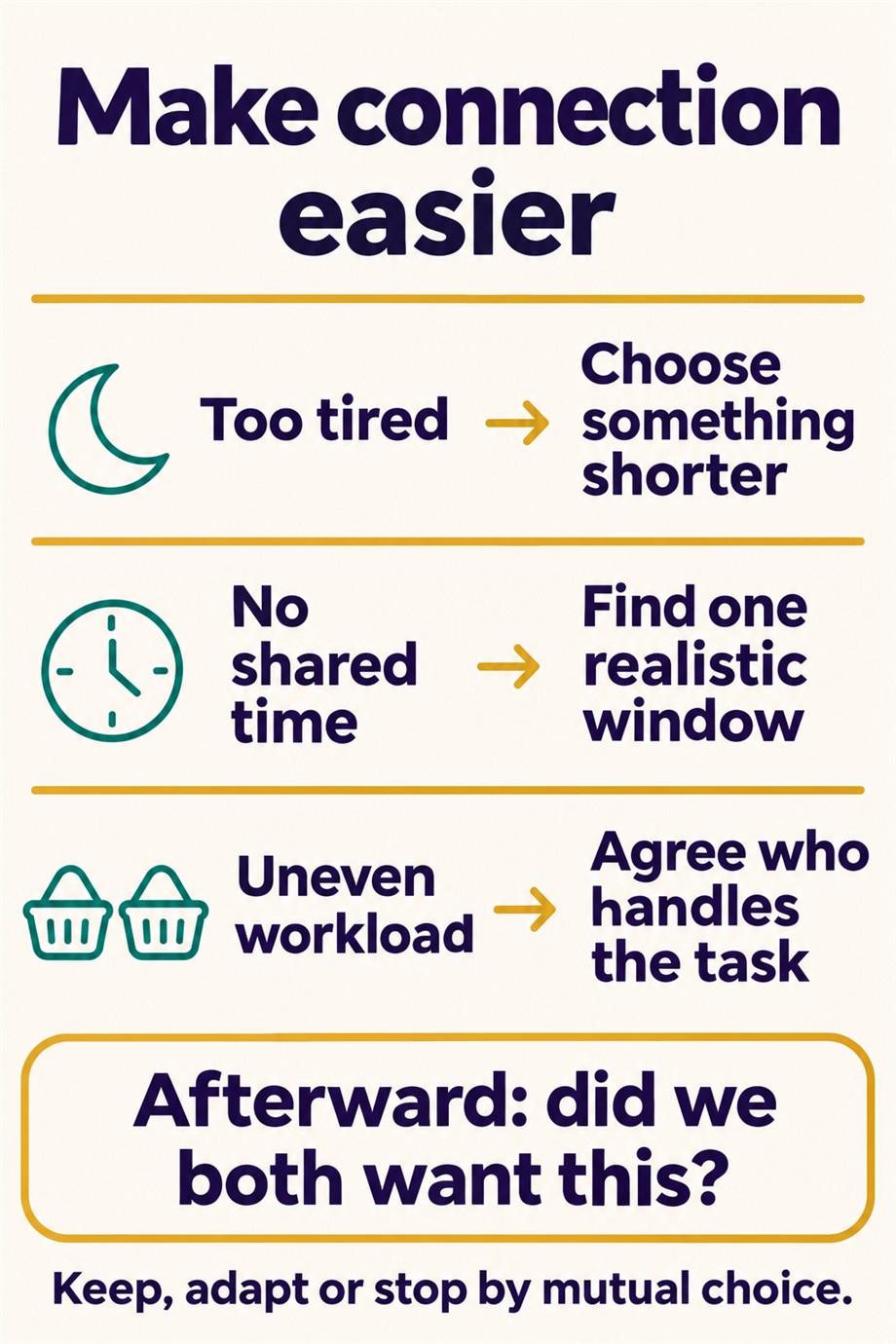
Keep the appealing part of an activity and remove an obstacle where you can. Cooking together may suit one couple; for another, it adds work to an already exhausting evening. Choose according to your energy, access needs, time and budget.
- If you are tired: try something brief and familiar, such as a shared snack, listening to one piece of music or sitting outside for a few minutes. Rest can be a reasonable choice too.
- If your schedules rarely overlap: look for one realistic window. It does not have to be an evening or a weekly date night. Agree on the time rather than surprising the other person with a commitment.
- If life feels repetitive: consider a different walking route, a free local event, a recipe or a class you both want to try. Novelty is an option, not a cure you have to purchase.
- If responsibilities are uneven: name the task and agree who will notice, plan and complete it. Adding a romantic outing while one person carries all the preparation may miss the problem.
Keep hobbies and friendships that matter to each of you. Separate interests are not automatically a threat to closeness. The question is whether the arrangement leaves room for both people and for the time you actually want together.
Let affection be welcome, not owed
You can ask what kind of affection feels good now: a hug, holding hands, a thoughtful message or simply sitting together. Check rather than assuming, including in a long marriage. Sharing chores, arranging a date or giving a gift does not earn physical intimacy.
RAINN explains that sexual consent must be clear, voluntary and ongoing. Being partners or having agreed in the past does not create an obligation now. If sexual pain or a change in desire concerns you, a qualified health professional can help you explore it without treating either person as defective.

A fictional example: make a smaller plan
Devon and Casey keep canceling a planned dinner out after long workdays. Devon feels unimportant; Casey feels that every invitation creates another obligation. They both say they want more relaxed time together.
Instead of booking a more elaborate evening, they agree to share a snack on Saturday afternoon. Casey checks what food is already available, and Devon handles the dishes. Either can ask to change the time. They do not attach a requirement for sex or a serious relationship discussion.
Afterward, they ask whether the plan felt enjoyable and manageable. If it did, they can choose to repeat it. If it felt forced, they can change the activity or discuss a different concern. Completing the plan is not proof that their relationship is repaired; its value is what they learn about the time they are choosing together.
Review the experience, not a romance score
Ask a few ordinary questions: Did we both want to be there? Could we say what we preferred? Was the effort shared in a way we accepted? Is there anything we would keep, change or stop?
Notice patterns across more than one moment without setting a deadline for feelings. An enjoyable afternoon can matter without erasing a trust problem. An awkward attempt does not prove you are incapable of love. Our guide to lasting love separates meaningful affection from promises about the future.
Recognize when shared activities are not the right next step
If conversations keep becoming hurtful, individual support or couples counseling may help you explore your options when both people participate freely and it is safe to speak. You do not have to wait for an activity plan to work before asking for help.
If there are threats, intimidation or coercive control, prioritize confidential support rather than a date-night exercise. The National Domestic Violence Hotline advises against couples therapy with an abusive partner. Use local emergency services if there is immediate danger.
You may eventually choose to keep working on the relationship, change its terms or leave. Repeated effort is not a duty to ignore your own answer. If you are considering separation, these questions before divorce can help you prepare for appropriate support and practical advice.
Questions about reconnecting with a partner
1. Can I make myself fall back in love?
You can explore what you miss and choose how you act, but feelings do not follow a command. Shared experiences may help you learn about the connection you have now. They cannot guarantee that romantic feelings will return.
2. What if my partner does not want to try?
Take their answer seriously rather than treating it as secret interest. You can ask what they mean if they are willing to explain, seek individual support and consider whether the relationship meets your needs. You cannot supply both people’s willingness.
3. Does having less sex mean love is gone?
Sexual frequency alone cannot establish what either person feels. Talk about comfort, desire and preferences without pressure. If pain or a change in desire concerns you, consider a qualified health professional. A partner never owes sex as proof of love.
4. Do we need an expensive trip or regular date nights?
No. Choose something you both want and can manage. A short walk, a shared snack or a quiet conversation can be an option. Travel or a class is worthwhile only if it fits your budget, energy and interests, rather than becoming another obligation.
5. How long should we try before deciding whether it helps?
There is no universal deadline for renewed feelings. Agree on a manageable check-in about the activity or change you are trying. Review whether it feels welcome and whether the underlying concern is being addressed; do not require affection by a target date.
6. Should we keep repeating a plan that feels forced?
You can adapt or stop a plan by mutual choice. Ask what made it uncomfortable and whether you want a different approach or outside support. Continuing indefinitely is not proof of commitment, especially when there is pressure, fear or a repeated disregard for your limits.