

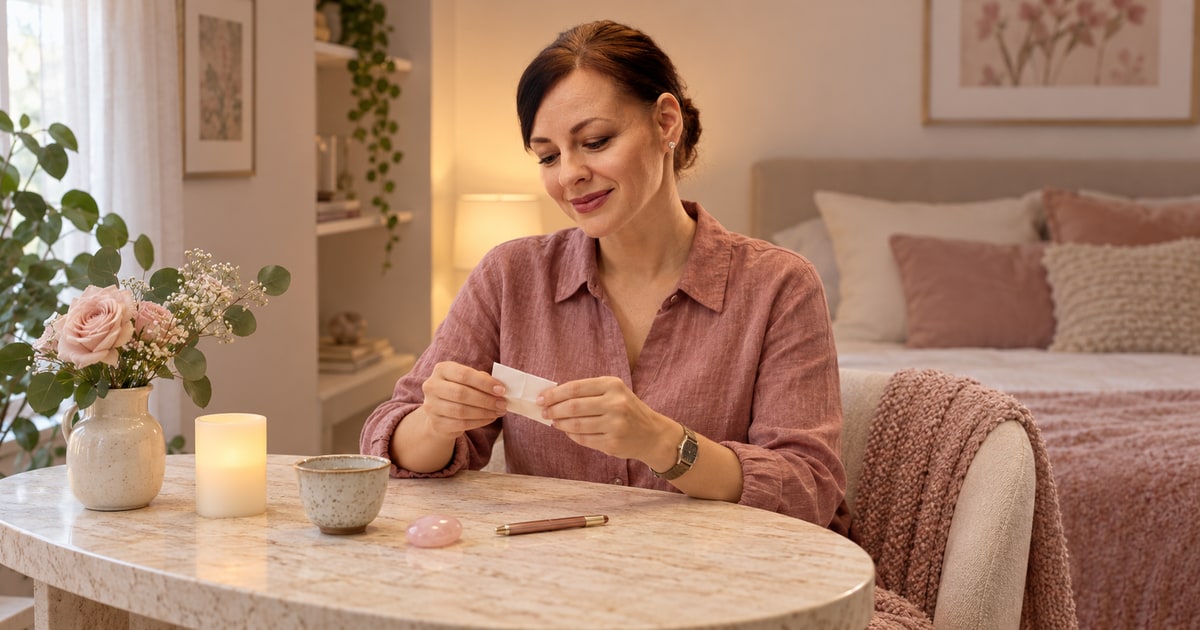
A love ritual can give hope, gratitude or grief a place to be expressed. If spiritual practice is meaningful to you, a quiet moment with paper, a cup of tea or a familiar symbol can help you name the kind of relationship you want to build.
Consent-based love rituals keep that intention connected to choices you can make. They leave another person free to participate, decline, change their mind or choose a different relationship. No ritual can guarantee love, reunion or commitment.
What makes a love ritual consent-based?
The intention should describe your own conduct: openness, honesty, patience, courage or the ability to accept an answer. An intention such as “I will make space for mutual affection” gives you something to practise. An instruction that a named person must return, surrender or stay attempts to assign them a choice.
When someone else is involved, explain the activity before asking. Say what you will do, what materials you will use and whether you intend to discuss anything personal. Give them an easy way to say no without an argument or a test of their love. A previous yes to one activity does not cover every later ritual.
“Would you like to spend ten minutes sharing what we appreciate and one thing we each need? It is fine to skip it, and we can stop whenever either of us wants.”
Ask again before touching someone, using their belongings, reading a private letter or sharing their photograph. Keep health details, relationship stories and messages private unless the person agrees to the particular use. Love is respect’s boundary guide explains how people can communicate comfort levels and change them without pressure.
Three gentle practices you can adapt
These are contemporary reflection exercises. Adapt them to your beliefs and accessibility needs. You do not have to recreate a tradition you have not learned or buy an object to make your intention meaningful.
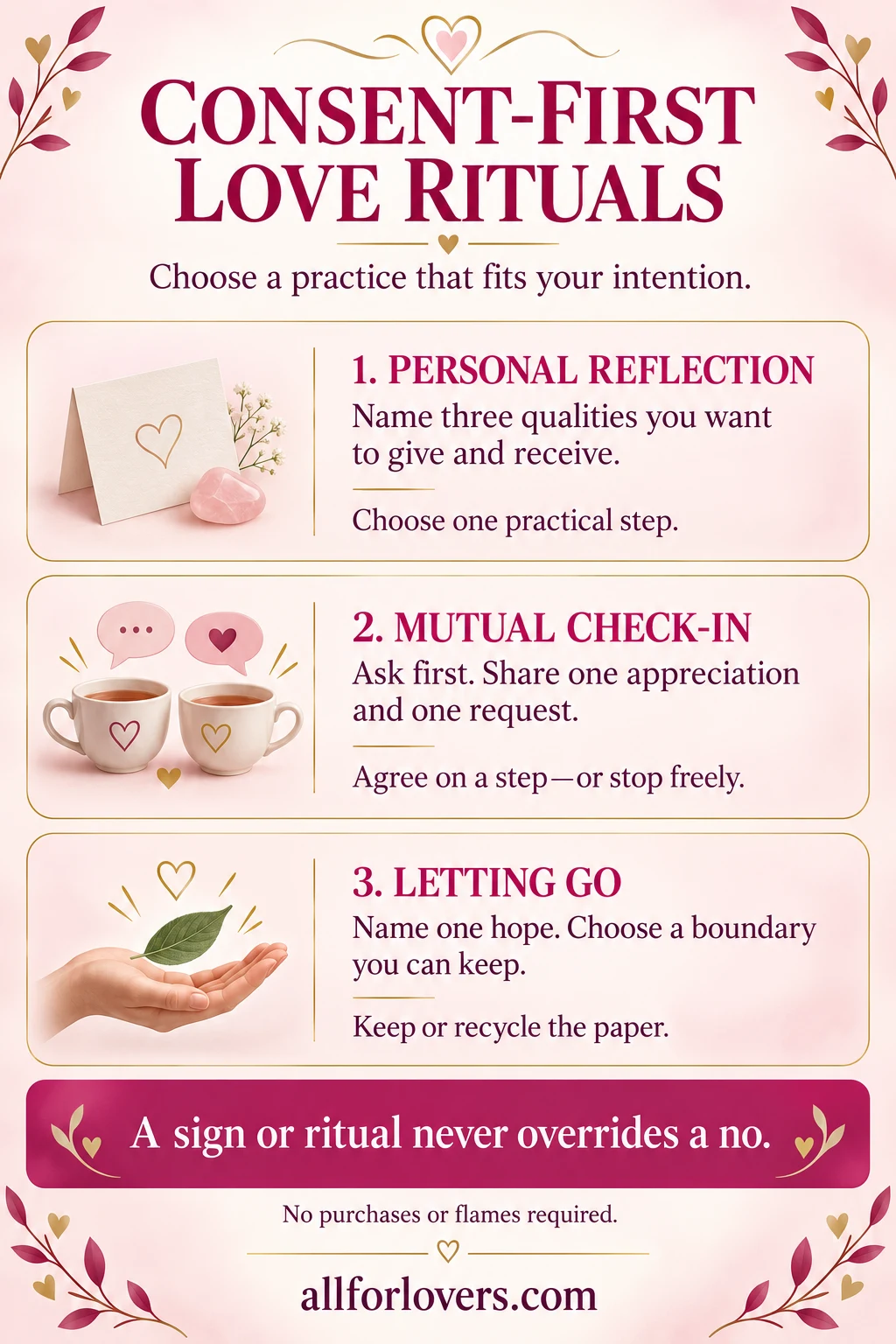
1. Make room for mutual love
You need: a small piece of paper and something to write with. A stone, flower or flameless candle can be an optional symbol.
- Choose three relationship qualities that matter to you, such as kindness, reliability and room to be yourself.
- For each quality, write one way you could offer it and one behaviour you would want to receive.
- Choose one practical step for the coming week: arrange a social activity, clarify a dating preference or practise an honest request.
- Fold the paper and keep it somewhere private. Return to it when you want to remember your priorities.
Example intention: “I welcome a connection in which care and choice are mutual.” The paper is a reminder; it does not bind anyone to you.
2. Share an agreed relationship check-in
You need: a comfortable setting and a time both people have agreed to. Tea or water is enough.
- Ask whether this is a good time and agree how long to spend.
- Each person names one recent moment they appreciated.
- Each person makes one specific request without guessing the other’s motives.
- Choose one small action you both accept, or agree to revisit the question.
- End when either person needs to stop. A ritual does not require touch, disclosure or agreement on every issue.
You might ask for an uninterrupted walk, clearer weekend plans or a quieter way to discuss a difficult subject. If one person dislikes spiritual language, a plain conversation can serve the same agreed purpose.
3. Let go of one expectation
You need: paper and a private place to reflect. This exercise can be done silently or without writing.
- Name the hope you have been carrying: a reunion, an apology or a particular timeline.
- Write what remains within your control today.
- Choose a boundary or supportive action, such as leaving an unsent message unsent or spending time with a trusted friend.
- Keep or recycle the paper. You do not need to burn it, bury it or leave it in nature.
Letting go can happen gradually. Sadness after a ritual does not mean it failed or that you must repeat it until a person returns. If you are making sense of an ex-related dream, see dreaming about your ex for a way to reflect without treating the dream as their answer.
Use symbols without overriding someone’s answer
A rose can represent affection, rose quartz can represent gentleness and a tarot card can prompt a question. Their meaning belongs to your practice. A dream, repeating number or reading does not give permission to contact someone who has asked for distance.
If you use cards, ask “What quality could I practise?” or “What boundary would help me?” rather than demanding confirmation that another person secretly agrees. In an unclear relationship, compare the agreements and behaviour you actually share.
Keep the setting simple and comfortable
Choose materials you can comfortably use and clean up. Skip smoke, fragrance or touch if they are unwelcome. An LED candle is a useful alternative to a flame. The U.S. Fire Administration recommends flameless candles; if you use a lit candle, use a stable holder, keep it at least 12 inches from anything combustible and extinguish it before leaving. Keep flames out of sleeping areas.
No costly ritual is required to prove devotion or remove an alleged curse. Stop if a service uses threats, secrecy or repeated payment demands. If you fear a partner’s response, seek confidential support rather than using a shared ritual to manage danger.
Let the intention become a daily choice
Review the action you chose, rather than searching for a promised result. Did you communicate more clearly, make time for friendship or respect a boundary? You can adjust the practice or leave it behind. The qualities in a strong, healthy relationship develop through how people treat each other over time.
Frequently Asked Questions
1. What is a consent-based love ritual?
It is a spiritual or symbolic practice focused on your own choices, with freely given agreement for any shared involvement.
2. Can I do a ritual alone?
Yes. Personal reflection can focus on your values, confidence, grief or boundaries without involving anyone else.
3. Can a ritual make someone love me?
No ritual guarantees another person’s feelings or decisions. Mutual affection remains their choice.
4. How do I invite a partner to join?
Explain the activity and ask plainly, giving them room to decline or suggest an alternative.
5. Can someone withdraw consent halfway through?
Yes. Stop or change the activity when either person wants to, without punishment or persuasion.
6. Do I need candles or crystals?
No. Paper, a spoken intention or a quiet moment can be enough; any objects are optional symbols.
7. Can I use someone’s belongings?
Ask for permission for the specific use. Having access to an item does not automatically make it yours to use in a ritual.
8. Does a dream mean my ex wants contact?
A dream can be meaningful to you, but it does not establish your ex’s wishes or override a no-contact request.
9. What if my partner has different beliefs?
Agree on an activity you both find comfortable, including a non-spiritual check-in or no shared ritual at all.
10. Must a shared ritual include touch?
No. Touch requires its own agreement and can be omitted without making the practice less meaningful.
11. Can I keep an intention about reconciliation?
You can acknowledge that hope while leaving the outcome open and respecting the other person’s present boundaries.
12. Should I burn a release letter?
You do not need to. Keeping, tearing or recycling paper avoids introducing a flame into the exercise.
13. How often should I repeat the practice?
Use it when it helps reflection. There is no required count, deadline or obligation to repeat it.
14. What if I feel sad afterwards?
Give yourself time and ordinary support. Sadness is not proof of failure or a reason to buy another ritual.
15. What is a useful next step?
Choose one action you control, such as an honest request, a social plan, a boundary or time with a trusted friend.