


Relationships can feel different at different times: new and curious, playful and close, busy with decisions, or quiet and strained. Calling these periods the “seasons of love” can give you a gentle way to talk about change.
The seasons are a metaphor, not a calendar or a test of whether someone is right for you. You might recognize more than one at once, return to an earlier feeling, or prefer different words altogether. What matters is what is happening between you now and what each person needs.
Spring: make room for discovery
Spring suggests curiosity and possibility. This may describe a new relationship, or an established one in which you are learning something new about each other. As your relationship grows, leave room for questions instead of assuming that attraction means you already know the answers.
Ask about everyday preferences and larger hopes: How do you like to spend an unplanned afternoon? What does commitment mean to you? How much time alone feels comfortable? Listen for differences as well as similarities.
A fresh connection does not have to be free of uncertainty to be worthwhile. You can enjoy it while taking time to see whether words and behavior fit together.
Summer: enjoy closeness without overfilling the schedule
Summer can stand for shared pleasure, affection and activity. It might be a trip, a favorite meal, a long conversation or a familiar joke. The point is enjoyment that both people welcome, rather than an impressive list of dates.
Check what each person actually finds restorative. One may want a busy weekend with friends; the other may need a quiet morning. A plan can include both preferences, but neither person should have to perform enthusiasm all the time.
Try asking, “What have we enjoyed recently that we would like to do again?” An answer such as cooking together may be more useful than deciding that you need an expensive romantic getaway.
Autumn: review what you are building
Autumn offers an image of taking stock. Perhaps your routines have settled, a job has changed, or you are considering a shared responsibility. Look at what your present arrangements make possible and where they create friction.
Choose one concrete subject: household work, money, visiting family, time together or future plans. What is each person expecting? Is the agreement still fair and realistic? What would you like to change?
Living together, engagement and marriage are possibilities, not required proof that a relationship has reached the right season. A useful next step is one both people understand and want.
Winter: name the difficulty and the support needed
Winter may describe distance, exhaustion, grief or a period with less energy for romance. Start with what you can observe. “We have hardly talked since the shift change” gives you more to work with than “Our love is dying.”
Ask whether the immediate need is rest, practical help, a clearer agreement, time to talk or support beyond the two of you. A quiet period does not establish that the relationship is doomed, and staying together does not automatically mean you have handled the difficulty well.
The metaphor should never turn repeated disrespect, coercion or ignored boundaries into weather you are expected to endure. Take the actual behavior seriously. You can seek support or reconsider a relationship without waiting for an imagined spring.
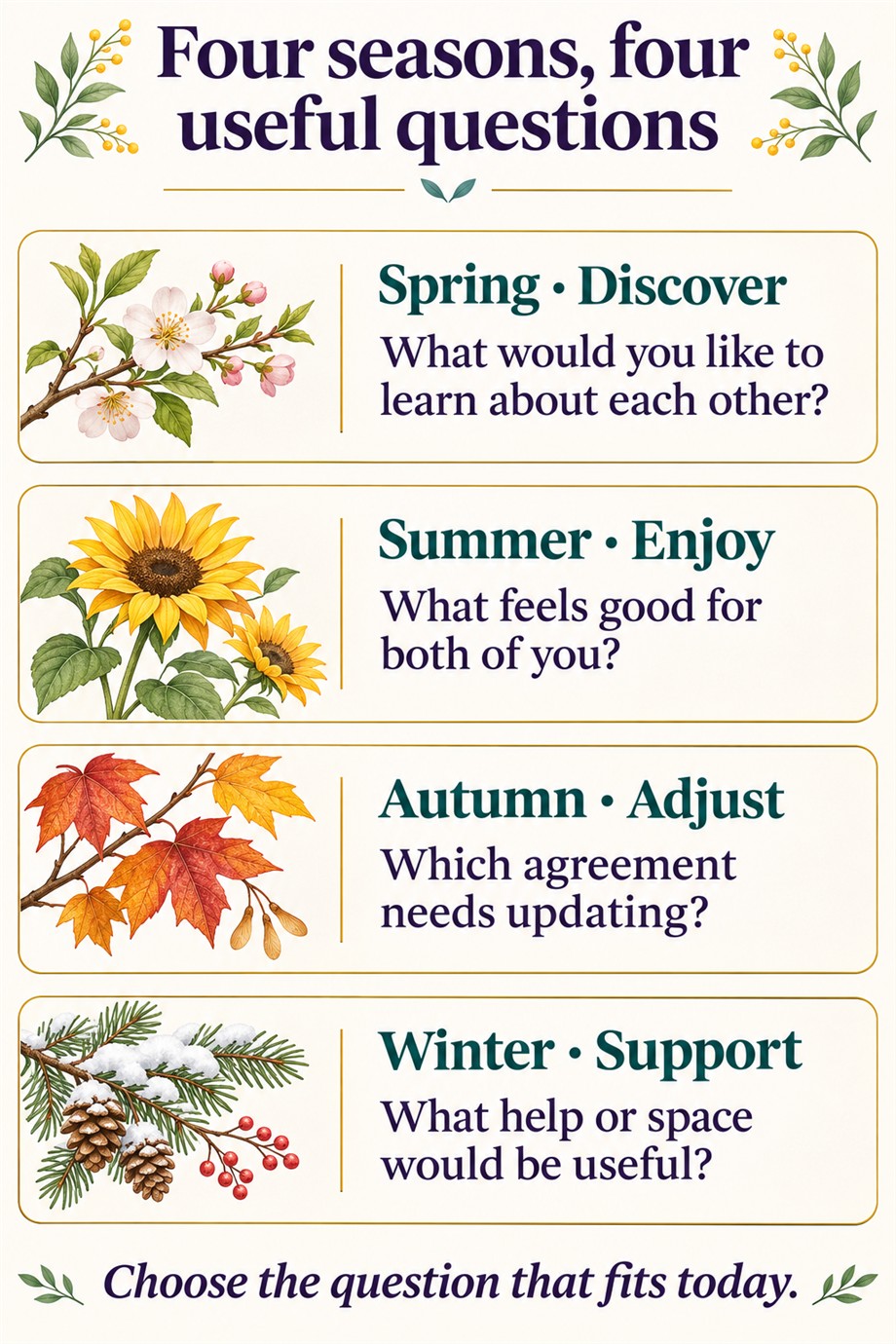
When you are describing different seasons
Imagine Alex and Robin after a change in work hours. Alex describes the relationship as winter because their evenings together have almost disappeared. Robin feels more like autumn: they are trying to establish a workable routine and do not think affection has faded.
Instead of choosing the correct label, they explain what it means. Alex misses unhurried contact; Robin needs to protect sleep. They agree to try breakfast together on two days off and a brief check-in about the coming week. After trying it, they can ask whether they feel more connected and whether the plan is sustainable.
The example works because the conversation moves from a broad image to a specific need. Their agreement may help, need adjustment or reveal another issue. No seasonal label guarantees the result.
A short check-in for the season you are in
- Name one observation. What has changed in ordinary life?
- Describe your experience. What do you miss, value or need more of?
- Invite the other person’s view. They may experience the same period differently.
- Choose a manageable next step. Agree on what each person will do and when to revisit it.
If a relationship ends, it does not prove that the whole connection was a mistake or that another one must follow on a schedule. You can take time to grieve, recover and decide what you want next.
Questions about the seasons of love
Are the seasons of love a fixed relationship timeline?
No. The seasons are a metaphor for different experiences. Couples may feel several at once, revisit them or find the metaphor unhelpful. It does not predict what happens next.
Does a difficult season mean we are incompatible?
Not by itself. Look at the particular difficulty, whether both people can discuss it and whether their actions change. Repeated harm or conflicting essential goals matter more than the seasonal label.
Do we have to get engaged or live together in the autumn stage?
No. There is no required milestone for a particular phase. Decisions about commitment, living arrangements and marriage depend on both people’s wishes and circumstances.
How can we reconnect during a quiet period?
Ask what has changed and choose a small, realistic form of contact that both people want. For example, agree on a short phone-free meal or a check-in after a demanding week, then notice whether it helps.
What if my partner and I describe different seasons?
Use the difference as a conversation starter. Ask what each label means in daily life and which need it points to, rather than arguing over who has named the relationship correctly.