


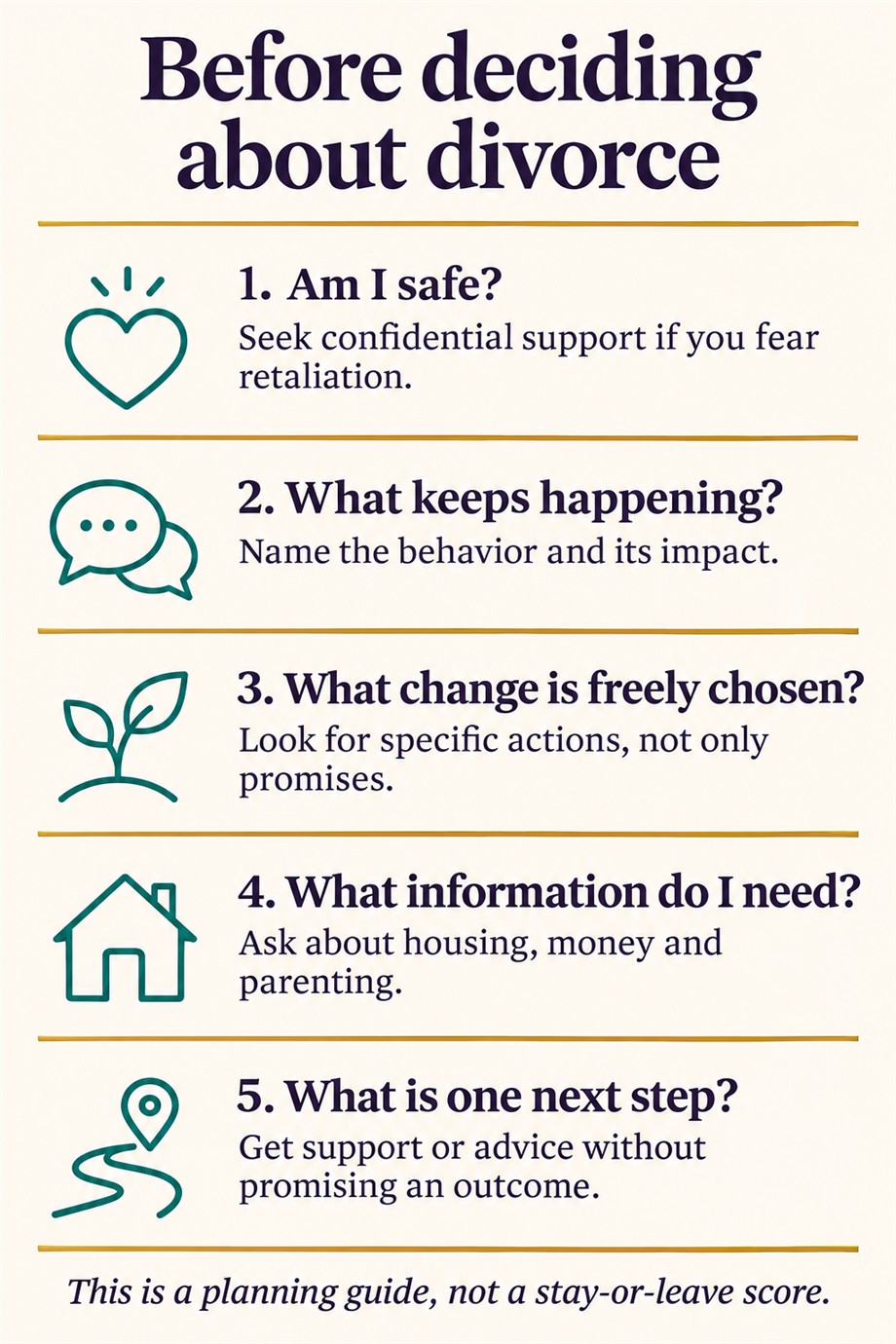
Before deciding about divorce, consider your safety, what is happening in the marriage, whether meaningful change is possible and what practical information you need. No checklist can make this decision for you. You can seek support and learn about your options without promising either to stay or to leave.
Loneliness, repeated conflict, a broken agreement or different plans for the future can all deserve serious attention. You do not have to prove that you tried hard enough before taking your concerns seriously. Looking at your own behavior can be useful, but it does not make you responsible for another person’s abuse, threats or choices.
Start with safety, not a relationship exercise
If you fear your spouse, the first question is what would help you and any children be safer. Abuse can involve threats, intimidation, monitoring, sexual pressure or control over money as well as physical violence. A conversation that seems ordinary to someone else may carry a different risk in your home.
The National Domestic Violence Hotline offers a personal safety-planning guide. A specialist service can help you consider your circumstances, including concerns about leaving, staying or communicating. Use a safer device if you suspect your activity is monitored. In immediate danger, contact local emergency services.
Do not use a confrontation or a trial separation to test whether an abusive partner will change. The Hotline advises against couples therapy with an abusive partner; something said together may be used against you afterward. Confidential individual support is a different option.
Describe the problem without diagnosing either person
Try replacing a global conclusion such as “Our marriage is broken” with a few specific observations. What happened? How often does it happen? What effect does it have on your daily life? What have you already asked for, and what happened next?
- Conflict or withdrawal: Can you discuss a concern without insults, punishment or fear? Is a pause followed by a return to the conversation, or does the issue remain impossible to discuss?
- Money, gambling or substance use: What concrete effects are you seeing, such as unpaid bills, broken agreements or unsafe behavior? A label alone does not tell you what will change.
- Children and future plans: Do you want different lives? A disagreement about having children is not necessarily a communication problem that either person should be persuaded to surrender.
- Affection and intimacy: Can you discuss loneliness, desire or distance respectfully? No spouse owes sexual activity, and pressure is not a solution to different needs.
- Trust: If an agreement was broken, is there clear acknowledgment and changed behavior, or only a request that you stop mentioning it?
You may recognize more than one issue. You do not need to turn the list into a score or prove that one issue is serious enough to count. Its purpose is to help you describe what you need support with.
Separate responsibility from blame
You can take responsibility for something you did—such as an insult, a threat or avoiding an agreed conversation—without accepting responsibility for everything in the marriage. The other person remains responsible for their behavior. Working on your own conduct does not guarantee that they will change, and it does not require you to remain married.
A more useful question than “Whose fault is all of this?” can be “What am I willing to change, what am I asking for, and what is the other person freely willing to do?” If the answer is unclear, record that uncertainty instead of treating a promise as evidence.
If you want to explore repair, make it specific
When it is safe and both people want to try, discuss one or two changes you can understand in practice. “Be more considerate” is hard to review. “If our plan changes, let each other know before the agreed time” describes an action. You might also discuss individual support or couples counseling when participation is voluntary and you can speak safely.
Choose a check-in that both of you agree to, and consider what you will look at then. Did the behavior change? Could you discuss setbacks honestly? Do you still want to continue? A review date is an opportunity to think, not a promise to forgive, stay or feel differently by then.
A fictional example: a plan is not proof
Nora and Ellis repeatedly argue about household responsibilities. Nora has been hearing “I’ll do more” but cannot tell what will be different. In a conversation where both feel safe, they agree who will handle two recurring tasks and when they will review the arrangement.
Nora writes down the agreement and what actually happens. If a task is missed, they can discuss that event instead of debating whether Nora is “too demanding.” If Ellis follows through, that is useful information about this agreement; it does not settle every concern in the marriage. If nothing changes, Nora does not have to treat the failed plan as proof that she failed.
Nora can also arrange an individual appointment to discuss her options. Gathering information is separate from making a final decision. This example describes an ordinary disagreement; it is not an exercise to use where there are threats or coercive control.
Get practical information before making commitments
Questions about housing, property, debt, support and parenting depend on the law where you live and your circumstances. Before signing an agreement or making a major change, ask a qualified local legal professional about the implications. If there is an urgent safety concern, seek specialist support with that concern rather than waiting to complete a checklist.
In the United States, USA.gov lists routes to free and lower-cost legal help, including eligibility-based services. In Canada, the Department of Justice’s divorce and separation guide explains why you need to identify which federal, provincial or territorial laws apply. Elsewhere, start with your local court, legal-aid service or lawyer-regulation body.
If it is safe, prepare questions for the appointment:
- What are my options, and what does each process involve?
- What should I understand about our home, accounts, debts and regular bills?
- If we have children, what needs to be arranged for their care and daily routines?
- Could moving out, relocating or agreeing to an informal arrangement affect my position?
- What documents may I need, what may I lawfully access, and how should I keep them?
- What costs, eligibility rules or deadlines should I know about?
These are questions to take to someone qualified to answer them, not instructions to move money, remove records or change a child’s arrangements. You can ask about costs and confidentiality before deciding whether to book.

Choose a next step small enough to take
You may not be ready to decide about the whole marriage today. A next step could be a confidential support call, a legal-information appointment, writing down the concern you want to discuss or asking a trusted person for practical company.
For a private note, use four lines: what is happening; what I need; what I still need to learn; one next step. Leave room for an unanswered question. Neither a spiritual interpretation nor someone else’s certainty can replace your own informed choice about the relationship.
Questions about considering divorce
1. Do I have to try couples counseling before deciding?
Counseling is an option when both people choose it and can speak safely, not a test you have to pass. If there is abuse or coercive control, seek confidential individual support; the National Domestic Violence Hotline advises against couples therapy with an abusive partner.
2. Does wanting a divorce mean I failed?
Wanting to consider divorce does not establish that you failed or caused every problem. You can reflect honestly on your own conduct while recognizing that the other person is responsible for theirs. There is no promise that changing yourself will repair the marriage.
3. What if my spouse does not want to talk?
You can still seek individual emotional support and local legal information. Their refusal is information about what is currently possible; you do not have to secure their participation before asking for help with your own choices.
4. Should I stay together for the children?
A slogan cannot decide that question. Consider the children’s safety, daily care and exposure to conflict, and seek advice appropriate to their needs and your circumstances. Get local legal advice about parenting arrangements instead of assuming what separation or staying would require.
5. Can a trial separation settle the decision?
A separation may give some people space, but it does not guarantee clarity or repair. If you are considering one, get advice about its legal implications and discuss practical arrangements only where it is safe. Do not use it to test an abusive partner.
6. How long should I take to decide about divorce?
There is no universal emotional timetable. You can take time to gather support and information, while responding promptly to urgent safety concerns or legal deadlines. If you receive court documents, ask a qualified local professional about the required response.
7. What should I prepare for a first legal-information appointment?
Prepare questions about your options, housing, debts, parenting, likely costs and any deadlines. Ask which documents are useful and how you may lawfully access them. You can also ask about confidentiality and available legal-aid services before booking.